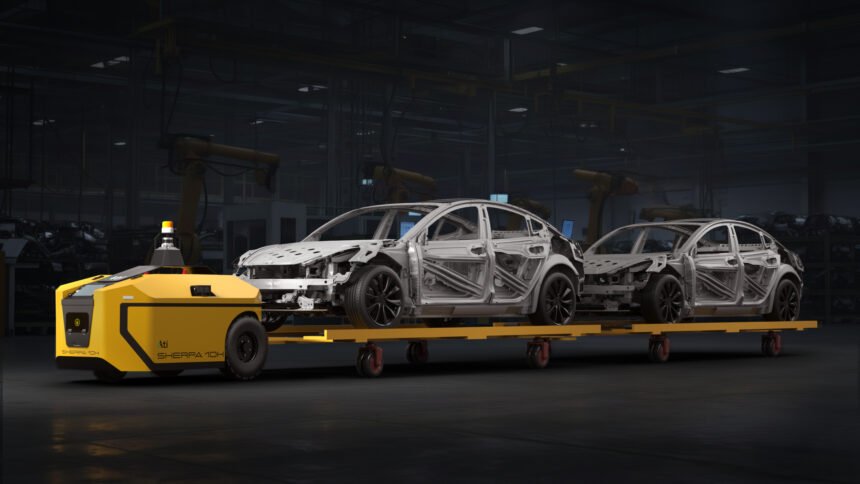
On a factory floor in Bengaluru, a bright yellow robot no bigger than a golf cart locks onto a trolley loaded with car body shells, hitches itself without a human hand in sight, and pulls away — 4,600 kilograms of steel gliding behind it as if it weighed nothing. The robot is the Sherpa 10K, the flagship of Ati Robotics, and it is already doing the same job in more than 70 factories around the world, from automotive plants in India to a tyre mega-factory in Japan and warehouses across the United States and Mexico.
Ati Robotics — formerly Ati Motors — was founded in 2017 by Saurabh Chandra and Dr Naveen Arulselvan, and born at the Indian Institute of Science in Bengaluru, where it was incubated. The company began by building motors for self-driving cars before pivoting to full robots, and today it designs, builds and ships its entire fleet from Bengaluru. Its Sherpa robots have completed more than 2 million autonomous missions, and the company says they run at a 99 percent mission success rate, deploy in about four weeks, and typically pay for themselves in under six months.
The tugger that pulls five tonnes
The Sherpa 10K is built for the heaviest job in the factory: moving trolleys of parts between stations, buildings and yards. It tows up to 10,000 lb — 4,600 kg — at up to 1.4 metres per second while laden, and it does it indoors and outdoors, in heat, dust and rain that stop lesser machines. A 48V LFP battery gives it an eight-hour shift on a single charge, with 0 to 80 percent in about an hour, and the whole machine is certified to ISO 3691-4, the international safety standard for industrial trucks.
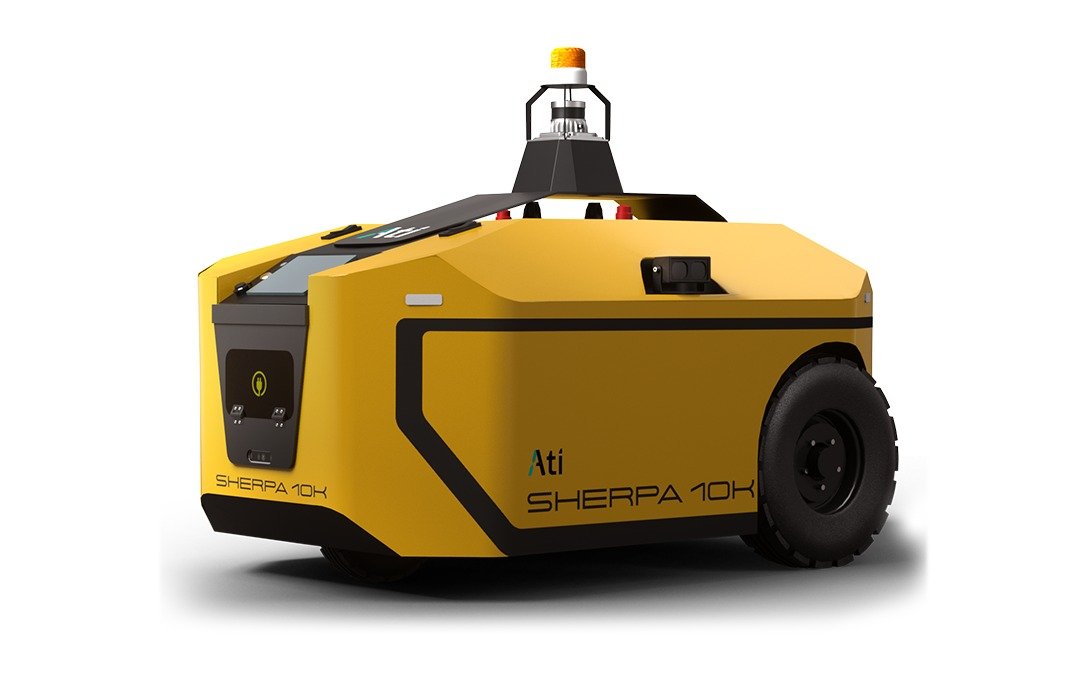
The Sherpa 10K, Ati Robotics’ flagship autonomous tugger. (Image: Ati Robotics)
What makes the Sherpa 10K more than a strong motor is its autonomy. 3D LiDAR fused with cameras lets it navigate factory floors with millimetre-level precision, turn in place in tight aisles, and — the trick factory managers love most — hitch and unhitch by itself. The robot reads a barcode on a trolley, attaches, tows the load to its station, detaches, and moves on to the next job, all without human intervention. It plugs straight into a plant’s ERP, warehouse and factory systems, speaks the VDA 5050 standard for mixed fleets, and answers to Ati’s fleet manager, which watches every robot, schedules every route and pushes software updates over the air.
More Read

One family, every job on the floor
The 10K is the heavyweight of a family of seven robots across five product lines, all running on the same intelligence platform. The Sherpa XT Lite handles lighter trolley work up to 1,500 kg, with a battery that swaps in under two minutes. Pallet movers, bin movers and lifting platforms cover the rest of the material-handling map, so a factory can automate the whole flow — trolleys, bins and pallets — with one supplier and one software brain.
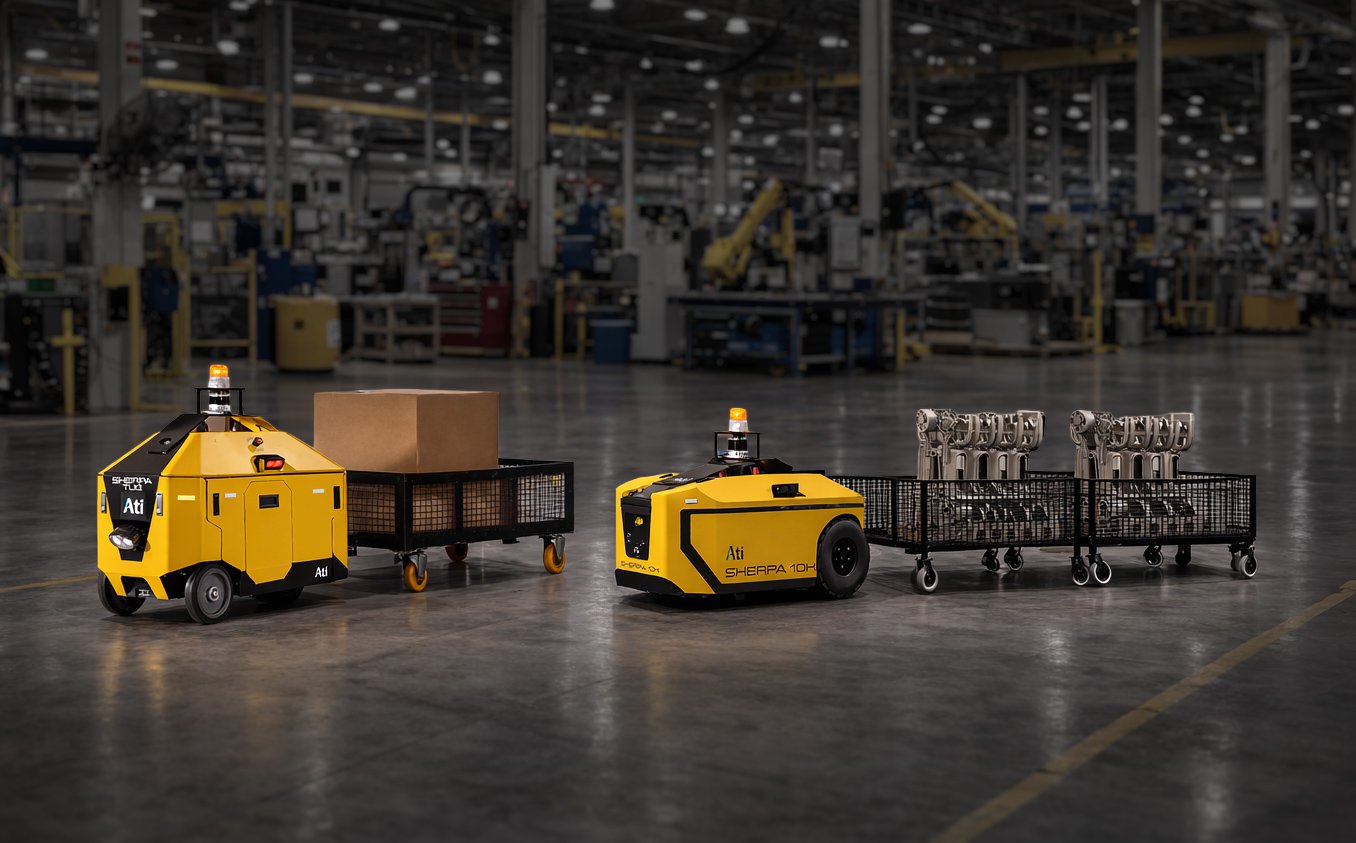
The Sherpa XT Lite (left) and Sherpa 10K (right) at work on a factory floor. (Image: Ati Robotics)
And then there is Sherpa Mecha, the newest member of the family. Unveiled at Ati’s Product Day 2025 at the IISc’s JN Tata Auditorium, Mecha is a dual-armed mobile manipulator on wheels — a humanoid-inspired machine built for factory work rather than imitation. Its carbon-fibre arms lift 12 kg with a metre of reach, swap tools instead of fingers, and take on machine tending, bin handling, part inspection and pick-and-place. The company says Mecha is now commercially available, offered to industrial teams and research partners as the next step in its vision of robots that do not just move material, but work on it.
Built in Bengaluru, running everywhere
Ati’s edge is that it builds the whole stack itself — mechanical design, navigation algorithms, sensor fusion and fleet software, all developed in-house in Bengaluru. That full-stack control is what lets the company promise four-week deployments in brownfield factories with no infrastructure changes, and it is what global manufacturers have bought into: the customer list spans Airbus, Bosch, Hyundai, Samsung, TVS Motor, Ceat, Forvia, Daimler, Cummins and Toyota Tsusho, with 15 Fortune 500 names among them, and around 80 percent of its customers in the automotive sector.
The scale shows in the deployments. At a Yokohama tyre mega-facility producing 4,000 tyres a day, Ati’s robots orchestrate more than 10,000 material-handling activities every single day. The company employs around 250 people worldwide and has raised about $37 million, including a $10.85 million Series A led by True Ventures and a $20 million Series B in January 2025 co-led by Walden Catalyst Ventures and NGP Capital. Robots are available to buy outright or through a robots-as-a-service model, so a factory can start automating without capital expenditure.
There is a strategic edge to where Ati builds, too. With the United States tightening rules around Chinese-made advanced robots, the company says its Bengaluru-assembled hardware carries almost no Chinese content — the 10K tugger is effectively China-free apart from battery cells that can be swapped to Korean or Japanese suppliers, and the pallet mover uses less than 5 percent Chinese parts. For American and European manufacturers rethinking their supply chains, a robot built in India has become a selling point in itself.
Teaching robots to see like humans
The newest chapter in the Ati story comes from a three-year research partnership with IIIT-Hyderabad’s Robotics Research Centre. On 27 October 2026, the two teams demonstrated an autonomous mobile robot navigating Ati’s own factory floor to a specific object using vision-language models and image-based 3D mapping — with no LiDAR, no scan-matched pose and no metric map. The robot found its way the way a person would: by understanding what it saw, not by measuring distances with lasers.
The code has already been transferred to Ati for testing and deployment in warehouse environments, and the company says it is now pushing the research toward what it calls the last two metres — the docking, pallet approach and narrow-bay threading where seconds saved multiply across a shift. It is the same instinct that has run through Ati since 2017: build the hard technology in India, prove it on real factory floors, and let the robots do the talking.
From a workshop at IISc to 70 factories across India, Southeast Asia, the United States and Mexico, Ati Robotics has turned a simple idea — that the hardest jobs in a factory should move themselves — into one of India’s most quietly successful deep-tech exports. The yellow robots pulling tonnes through the aisles are the proof, and they are only getting started.
Keep reading: The Nose in Every Chimney: Inside Adage Automation, the Goa Company Reading India’s Industrial Gases · Forty Chips, One Leap: Inside L&T Semiconductor, the Fabless Arm Putting India on the Silicon Map · More Industrial Automation & Technology stories
Like stories like this? Add Exceptional Technology as a preferred source on Google to see more of our reporting in your search results and Discover feed.