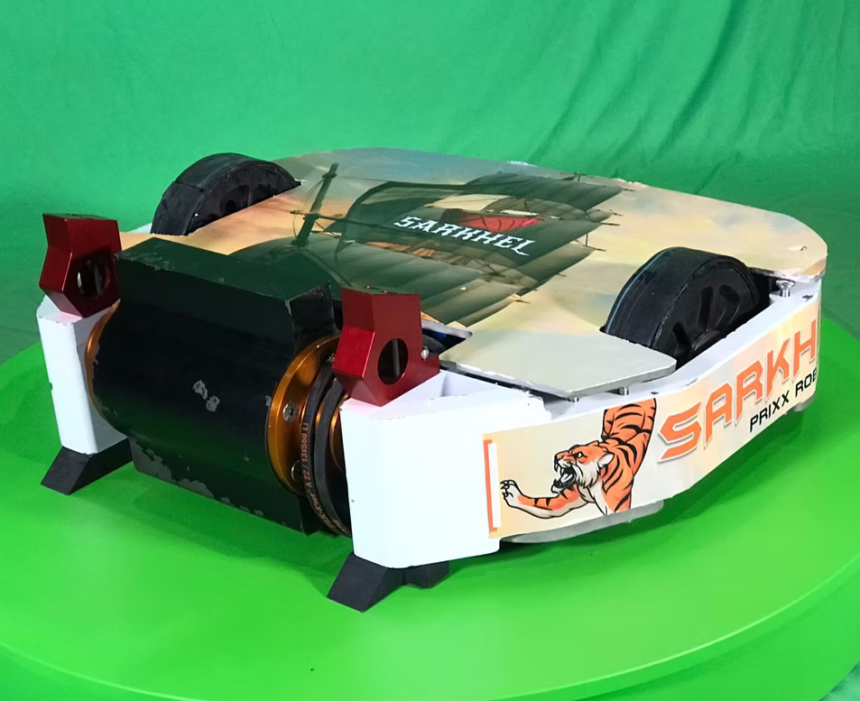
On 31 October 2026, inside the Kazan Expo Centre in Russia, a 110-kilogram machine built by engineering students from Pune stood among the four best combat robots on the planet. Sarkhel, the heavyweight fighter built by Prixx Robotics, a student-led team from the Padmabhooshan Vasantdada Patil Institute of Technology (PVPIT) in Bavdhan, had fought its way through a field of 144 teams from 11 countries at the Battle of Robots championship — and finished fourth in the world.
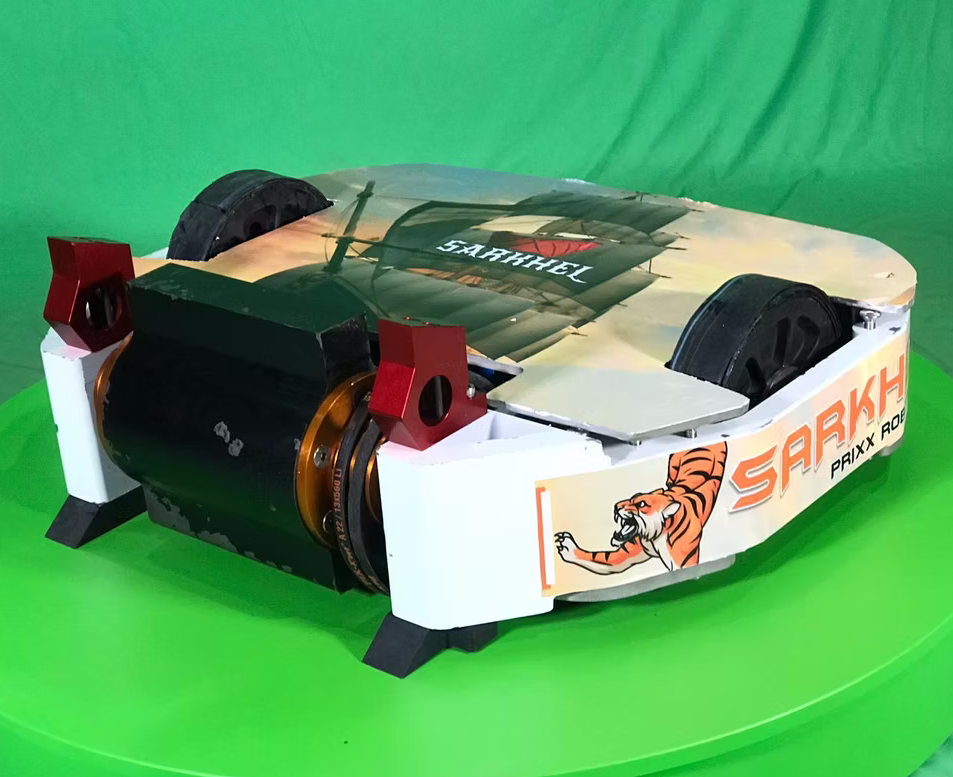
The machine
Sarkhel is a two-wheel-drive heavyweight, and the team says it is India’s only 2WD machine in the 110-kilogram class — a layout the team chose deliberately, trading the stability of four wheels for the precision and control of two. At the front of the low, white-and-orange chassis sits the weapon that defines it: a 35-kilogram spinning drum that the team says reaches 12,000 RPM and stores around 70 kilojoules of rotational energy at full speed, enough to launch an opponent into the air on contact.
For the 2026 championship, the team rebuilt the machine from the inside out over eight months. The older brushed drive motors were replaced with higher-output brushless motors, paired with custom-built gearboxes to put the power down. The team says the drivetrain upgrades pushed Sarkhel’s top speed to nearly 74 kilometres per hour, and powerful magnets underneath help the machine grip the arena floor while its drum spins up. The electronics are the team’s own work, built and tuned in their workshop at PVPIT.
The machine wears its identity proudly. Sarkhel is the title of the commander of the Maratha navy, and the robot carries the words “Maratha Naval Command” and the registration IND MH19, with flame graphics and two sculpted tiger heads flanking the spinner, and orange-red lights glowing on the drum. It is a machine built to be recognised — and, in the arena, to be feared.
Three seconds from elimination
The run to fourth place had its moment of real drama in the bout against Baikal Beasts, a Russian university team, and their robot Babr Monster. A heavy collision left Sarkhel briefly immobilised near the edge of the arena, and the knockout countdown was nearly done. With just three seconds remaining, the pilot brought the machine back to life — and Sarkhel went on to disable the Russian robot’s drivetrain and take the bout.
The run ended in the semifinals against Brazil’s Team UFO, who went on to finish second overall. The final standings told the story of a genuinely international contest: Russia’s Daddy Bots took first place, Brazil’s UFO Combat second, China’s Fierce Roc third, and India’s Prixx Robotics fourth — ahead of 60 other heavyweight contenders.
More Read

Built over years, not months
The result was no debut. Prixx Robotics has been taking machines to Russia’s Battle of Robots since 2023, competing in consecutive editions alongside domestic robowars events across India, and the team fields robots in the under-20-kilogram, under-60-kilogram and under-120-kilogram categories as well. Along the way it has collected wins including first place in the 60-kilogram Robowar at Parul University’s Projection 2025, and first prizes in the 8-kilogram Robowar and Virtual Robotics at COEP MindSpark 2026. The team also fields a second heavyweight, Milestone, and runs a junior programme that builds smaller machines and trains new members.
The achievement has already drawn attention back home. On 7 November 2026, a delegation from the Consulate General of the Russian Federation in Mumbai, led by Consul General Ivan Y. Fetisov, visited the PVPIT campus and toured the Prixx Robotics lab, watching the students demonstrate their machines. The team is now looking for commercial partners and sponsors for its next season — and for the next evolution of Sarkhel.
From a college workshop in Bavdhan to a semifinal in Kazan, Sarkhel is what happens when students are given a workshop, a deadline and a world stage: a 110-kilogram machine, spinning at 12,000 RPM, carrying the name of a Maratha naval commander into battle against the best in the world — and coming home fourth.
Keep reading: The Hands That Teach Robots: Inside Humyn Labs, the Bengaluru Startup Turning Real Work Into Robot Training Data · The Muscle Inside Every Robot: Inside Cosine Robots, the Bengaluru Startup Building the Joints That Move Machines · More Industrial Automation & Technology stories
Like stories like this? Add Exceptional Technology as a preferred source on Google to see more of our reporting in your search results and Discover feed.