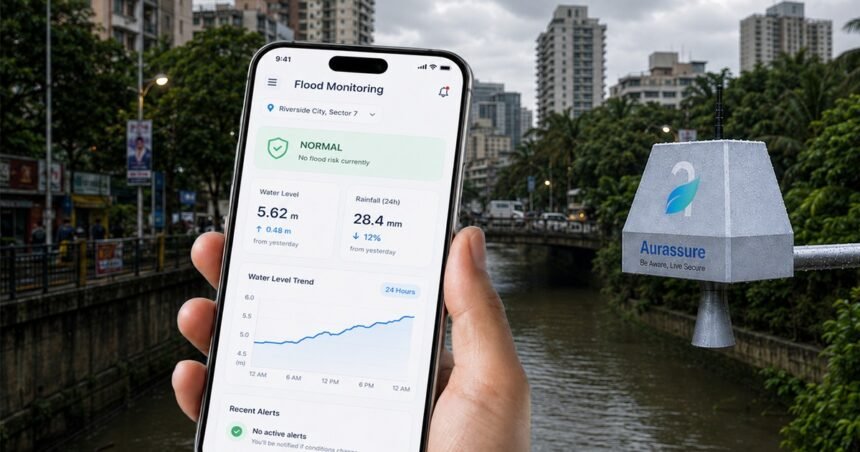
In most Indian cities, the first sign of a flood is water already ankle-deep in the street. By the time anyone calls for pumps and barricades, the drain has overflowed, the underpass is closed and the traffic has nowhere to go. A Bhubaneswar company has spent four years asking a different question: what if the city knew the water was rising while it was still just millimetres?
Aurassure, founded in Bhubaneswar in 2022 by Akanksha Priyadarshini, builds a hyperlocal environmental intelligence network — rugged IoT sensors on streets, canals, rooftops and factory fences, feeding a single AI platform that turns raw readings into early warnings. The company says its systems now watch over more than 300,000 square kilometres and 200 million people across India and seven other countries, from city flood networks to factory air-quality grids.
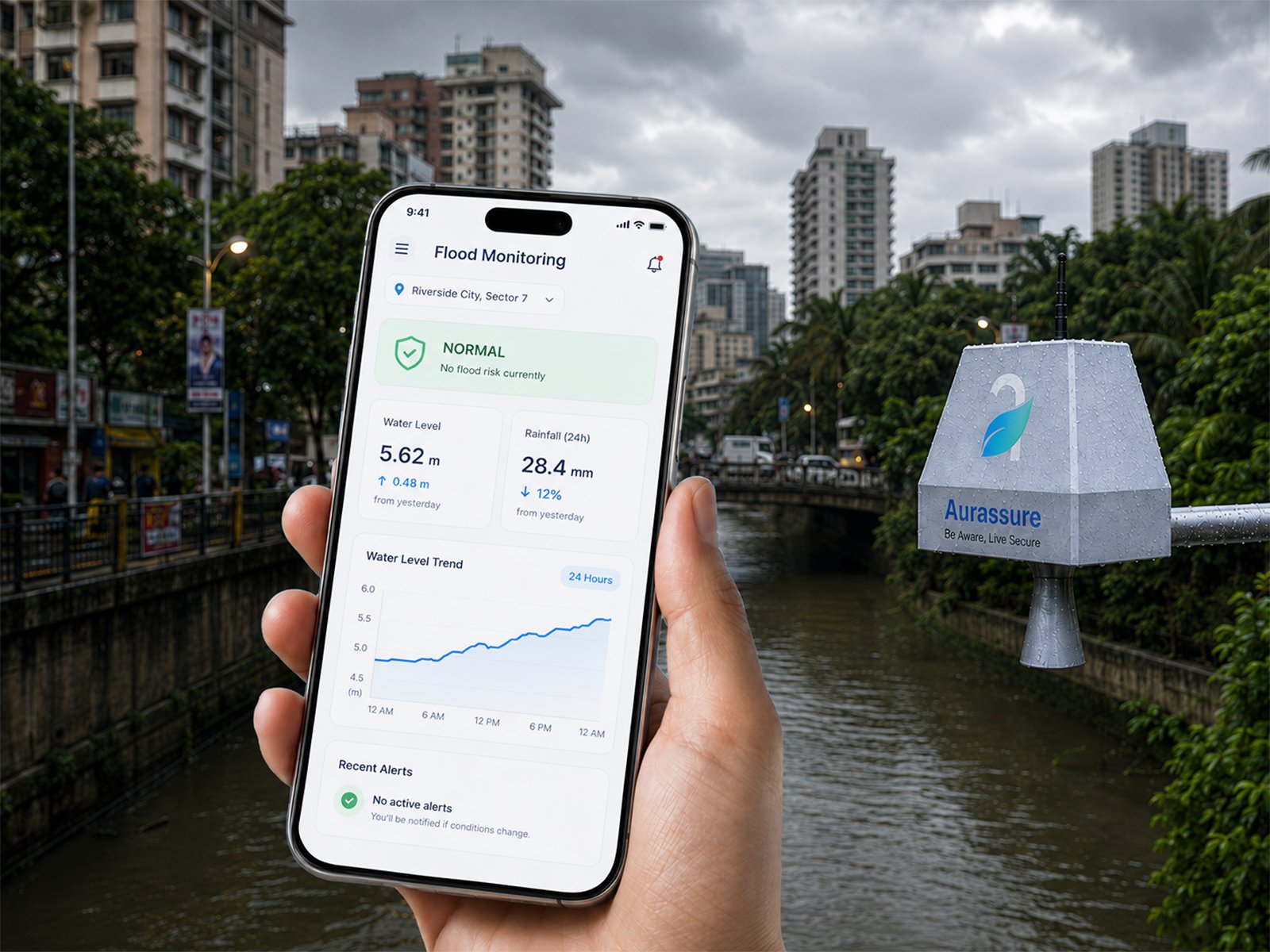
Aurassure’s Aqua flood-monitoring unit beside its app, from the company’s press material.
A sensor that watches the drain, not just the sky
The flagship of the flood story is Aurassure Aqua. The unit tracks water levels with microwave radar sensing accurate to ±2 millimetres, alongside rainfall, temperature, humidity, wind and pressure, and streams the data to a live dashboard with updates configurable from 15 seconds to 15 minutes. When a threshold is crossed, the platform fires alerts through dashboards, SMS, email, public displays and city command centres — so pump stations, traffic teams and disaster managers move on the same live picture.
The deployments show what that looks like at city scale. In Chennai, the company says it has deployed 45 water-inundation sensors and 30 rainfall sensors across canals, pathways and sumps, feeding trends, forecasts and early warnings into the smart-city response. In Kolkata, Aurassure supports the municipal corporation’s city flood monitoring system and early-warning operations, which the company describes as India’s first comprehensive city-level early-warning system. In Mumbai, its monitoring supports climate research and flood-risk planning for flood-prone neighbourhoods.
More Read
From nine sensors on a campus to a 48-hour forecast
One of the most exciting deployments sits on a university campus. In August 2026, Aurassure installed nine Aqua flood and weather monitoring units at IIT Bombay, giving researchers a stream of real-time, hyperlocal rainfall and water-level observations to feed AI-based urban flood forecasting. The research aims at forecasts up to 48 hours ahead — the difference between a city that reacts to a flood and a city that prepares for one.
The company says its flood work has topped 90% accuracy in flood-management applications, and its platform resolves air and weather down to about a square kilometre, and heat down to about 100 square metres — street-level detail where a city-wide forecast is only a blur.
One platform, five senses
Flood is only one sense in the Aurassure family. Infra watches industrial air quality — PM2.5, PM10, carbon dioxide, nitrogen dioxide, sulphur dioxide, volatile organics and noise — for compliance and public-health reporting. Trust is the construction-site and city monitor, Care is the indoor air-quality device for homes, offices, hospitals and schools, and the AWS weather station tracks wind, rainfall, soil moisture and solar radiation for hyperlocal forecasts. All of them feed the same Aurassure platform: live dashboards, historical trends, forecasting workflows and alerts in one place.
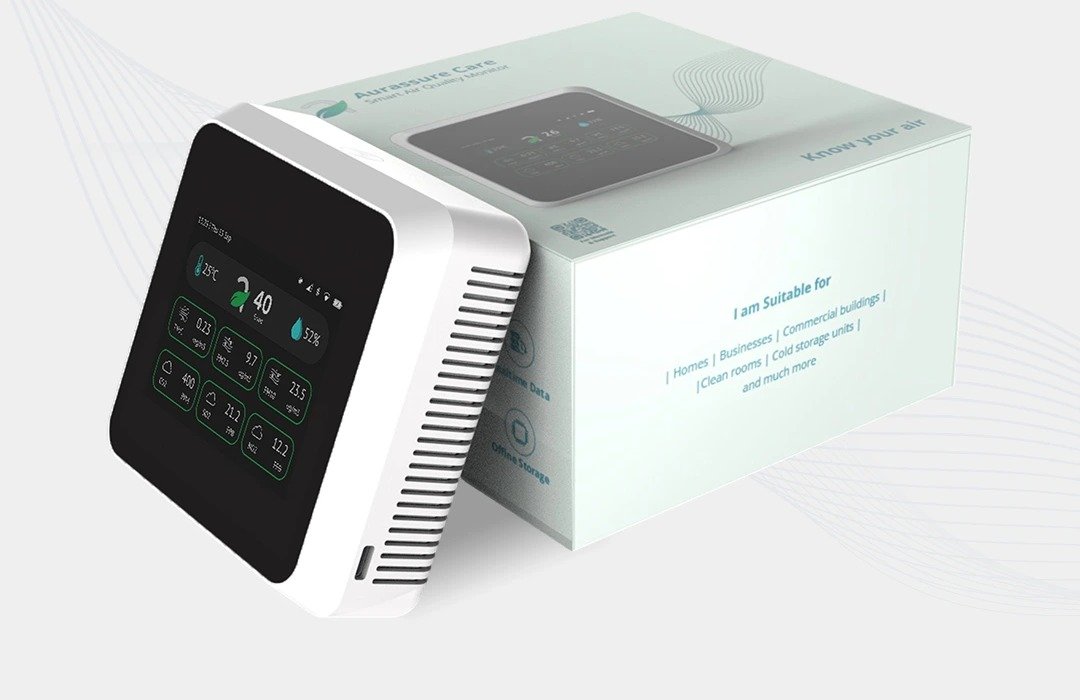
Aurassure Care, the company’s indoor air-quality monitor.
The customer list reads like a tour of India’s institutions and industry. The company counts Google, Jindal Steel, Honeywell and the Indian Council of Medical Research among its partners, and says it serves more than 75 customers across 165 cities — from a plant-wide environmental network at Jindal Steel’s Angul facility and a large air-quality research network for ICMR-NIREH, to indoor air monitoring in hospitals, malls and schools. Its Care monitor has been recognised by RESET as an accredited air monitor, and the company won the Good Air Award in 2024.
Built from a personal question
The idea began close to home. When Priyadarshini’s mother developed asthma after moving to Rourkela, the family discovered how little neighbourhood-level air data existed to answer a simple question: is the air around us safe today? Priyadarshini, who brings more than a decade of hardware engineering experience, built Aurassure to close exactly that gap — first for air, then for weather, heat and water.
The company raised ₹25 crore in a pre-Series A round in 2025 from Unicorn India Ventures and Rainmatter, and in 2026 it was selected for the Google for Startups Accelerator’s India cohort — a cohort chosen from around 2,500 applicants for specialised, industry-focused AI. From its Bhubaneswar headquarters, with offices in Noida and São Paulo, Aurassure is now building the quiet infrastructure of climate resilience: sensors that never sleep, so that the next time the rain comes hard, the city is already watching.
Keep reading: One Tonne, One Square Metre: Inside ANSCER’s ATR 1000, the Robot That Lifts, Spins and Hauls · From Words to Walls: Inside Tagbin’s BRIXX, the AI That Designs Buildings in Days · More Industrial Automation & Technology stories
Like stories like this? Add Exceptional Technology as a preferred source on Google to see more of our reporting in your search results and Discover feed.