


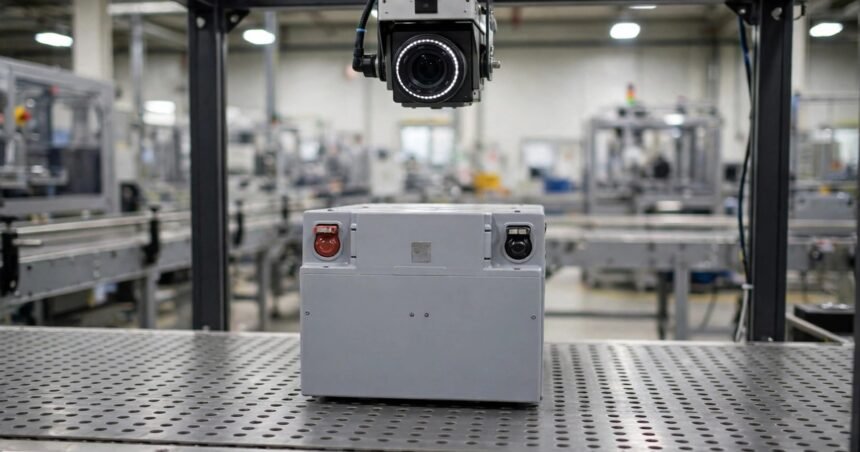
On a battery production line, a camera watches every pack roll past and an AI model calls each one good or bad. The model is 99 percent accurate, which sounds excellent until you do the arithmetic: one call in a hundred is wrong, and the model cannot tell you which one. A good battery gets scrapped. A bad one slips through. And when the light shifts, the lens ages or the line changes pace, the model’s accuracy quietly slides — and the only fix is to stop the line, send data to the cloud, retrain the model and install it again. That is the problem a Hyderabad startup set out to erase: not by building a better model, but by building a watcher that sits beside the model and corrects it while the line keeps running.
The company is Edgeble AI, and its product is a self-correcting runtime for physical AI. It sits beside a factory’s deployed model, on the device itself, and checks every claim the model makes — this part is defective, this lane is clear, grasp here — in about 13 milliseconds. When a claim is wrong, the runtime corrects it before it becomes a decision. When wrong claims repeat, it finds which layer moved — the sensor, the chip or the model — fixes that layer on the device, and writes a signed record of the whole thing. The model itself stays sealed; nothing leaves the device, and the line never stops for a model change.

The model that fixes itself
Edgeble describes its runtime in three moves: catch, fix, prove. First it judges every claim in milliseconds against evidence the model never had, correcting the wrong ones on the spot. Then, when overrides repeat, a second stage works behind the first: it traces the cause — a lamp drifting through the PLC, a frame budget slipping on the chip, a model drifting as parts change — and fixes it at that layer, with a small on-device retrain of the model’s head if the model is the problem, swapped in live and rolled back in seconds if it must be. Finally it proves the fix: one line per claim, the evidence, the verdict, every gate and every swap, written as a by-product of running — the record the company says the EU AI Act and ISO/PAS 8800 ask for. The runtime governs the models factories already run — YOLO, classifiers, PP-OCR, Qwen2, even vendor-sealed models — across NPUs, GPUs and runtimes from RKNN to ONNX, so it drops into lines that are already built rather than asking for them to be rebuilt.
Nine wrong calls, caught live
The company’s proof is a battery line in production, filmed in October 2026. On the left of the footage, the installed model rejects good batteries; on the right, the same frames run with Edgeble’s runtime beside the model, and the good packs pass. The company says the run caught nine of nine wrong claims on the live line, learned 53 of 53 labels on-device, corrected 11 of 12 drift events, and stopped the line zero times for a model change. Four of the six causes of wrong claims, the company notes, were not the model at all — they were the sensor, the chip and the physical world around them. It is a small, telling detail: most of what breaks factory AI is not the AI.
More Read


From a chip module to a runtime
Edgeble’s roots are in silicon. Founder Jagan Teki spent 18 years in semiconductors and embedded systems at Xilinx and Applied Micro, maintains U-Boot, works on the Linux kernel and RISC-V, and holds five patents; co-founder Srinivas Patnaik brings 18 years in automotive, mechatronics and edge AI products. The company began in 2022 in Hyderabad, and spent two and a half years in R&D before its first deployment — Teki had seen the problem first-hand in 2019, deploying an AI defect-detection system that could not adapt without the cloud. Its hardware, the Neu2 and Neu2K neural compute modules, packs a 2-TOPS NPU, up to 4 GB of memory and 16 GB of storage into a module the size of a credit card, and the self-learning modules built on it are priced from $200 to $850. The same technology ships as a runtime that upgrades edge devices already on the floor, and the company is developing its own self-learning NPU chip — deliberately, Teki says, only after proving the technology solves real problems in the field.
In factories, on bikes, and beyond
The runtime is already at work where the stakes are highest. Amara Raja Batteries uses it for battery production automation, Hero for on-bike intelligence, and the company’s deployments and trials span Patil Group, Collins Aerospace, Apollo Tyres and Nissan, with the platform also serving defence, medical devices and agriculture. Edgeble is bootstrapped and raising seed funding, and the company says it plans to deploy 15,000 to 25,000 edge nodes globally across industrial automation and automotive over the next two years. It is a small team — the two founders and five engineers on the device — building for a world in which every machine carries its own intelligence. If they are right, the factories of the next decade will not just run AI; they will run AI that notices when it is wrong, fixes itself, and keeps the line moving.
From a Hyderabad workbench to battery lines, bikes and aircraft suppliers, Edgeble AI is showing what happens when the intelligence on the factory floor learns to doubt itself — and correct itself — in 13 milliseconds, without ever asking the cloud, or the line, to wait.
Keep reading: The AI That Learns How India’s Power Grid Thinks: Inside Arborum Labs’ World Models · The Machine That Catches Every Flaw: Inside CountAI’s Knit-I, the AI Watching India’s Knitting Floors · More Industrial Automation & Technology stories
Like stories like this? Add Exceptional Technology as a preferred source on Google to see more of our reporting in your search results and Discover feed.









