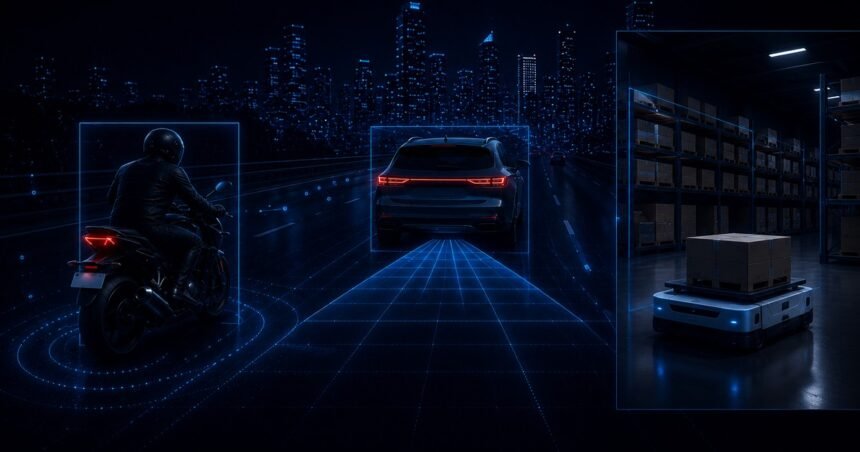
Every day, millions of Indians ride into traffic that gives them almost no margin for error — a scooter squeezed between a bus and an auto, a bike threading through a junction where everyone is improvising at once. Cars have spent a decade gaining cameras, radars and software that watch the road and warn the driver. Two-wheelers, the vehicles that carry most of India, have largely been left to the rider’s eyes alone. A Bengaluru deep-tech startup is changing that, with an edge-AI perception stack built from the ground up for the two-wheeler and for Indian roads.
The company is EdgeVerse, founded in 2023 by Arindam Ghosh, Subrata Debnath and Navaneeth A. Its flagship product is Perceiva ARAS, an Advanced Rider Assistance System software stack that fuses camera and radar inputs to give a two-wheeler something close to a sixth sense: forward collision warning, blind spot detection, lane advisory and predictive collision alerts, all computed on the vehicle itself, in real time, with no dependence on the cloud. The company says the stack is hardware-agnostic, so it can work with existing camera and radar architectures, and it is also developing an integrated ARAS solution that bundles its own processor hardware, sensors and perception software into one package.
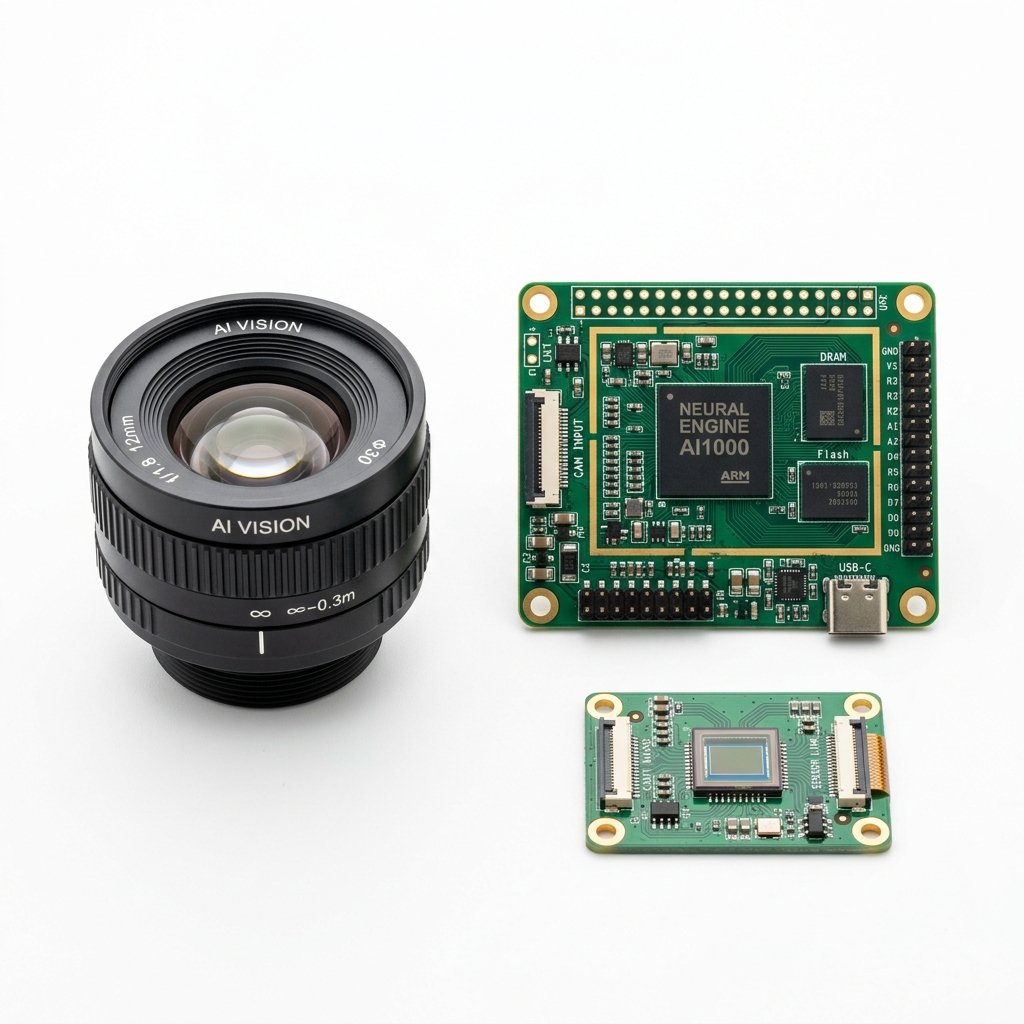
The engineering problem EdgeVerse set out to solve is a tight one. A car can hide a radar behind its grille, a camera behind its windscreen and a power-hungry computer somewhere in its bulk, all inside a bill of materials measured in lakhs. A two-wheeler offers none of that slack: the whole vehicle can cost less than a car’s sensor suite, the battery is small, there is nowhere obvious to mount anything, and every gram and every rupee is contested. EdgeVerse says it designs against that constraint rather than around it, building edge-native AI that runs lean on its own processor board and camera module — hardware the team built in-house and has already put through on-road testing for front- and rear-collision detection in Bengaluru.
That India-first engineering is the heart of the story. India is the world’s largest two-wheeler market, with an estimated 375 to 400 million two-wheelers already on its roads, and the company says its perception models are trained for the traffic those riders actually face: mixed lanes, sudden crossings, vehicles of every size and shape, and conditions that change with the monsoon. The company has demonstrated its technology to potential customers including Ather, and says it is engaging with players across the mobility ecosystem such as Cavli and Qualcomm, alongside advanced talks with large global Tier-I suppliers building India-focused camera, radar and edge-AI solutions. Over the next six to twelve months, the company plans to build an Indian road dataset covering 100,000 kilometres, develop a 2MP camera and a 77 GHz radar module, and secure multiple commercial agreements for its ARAS and driver-monitoring solutions.
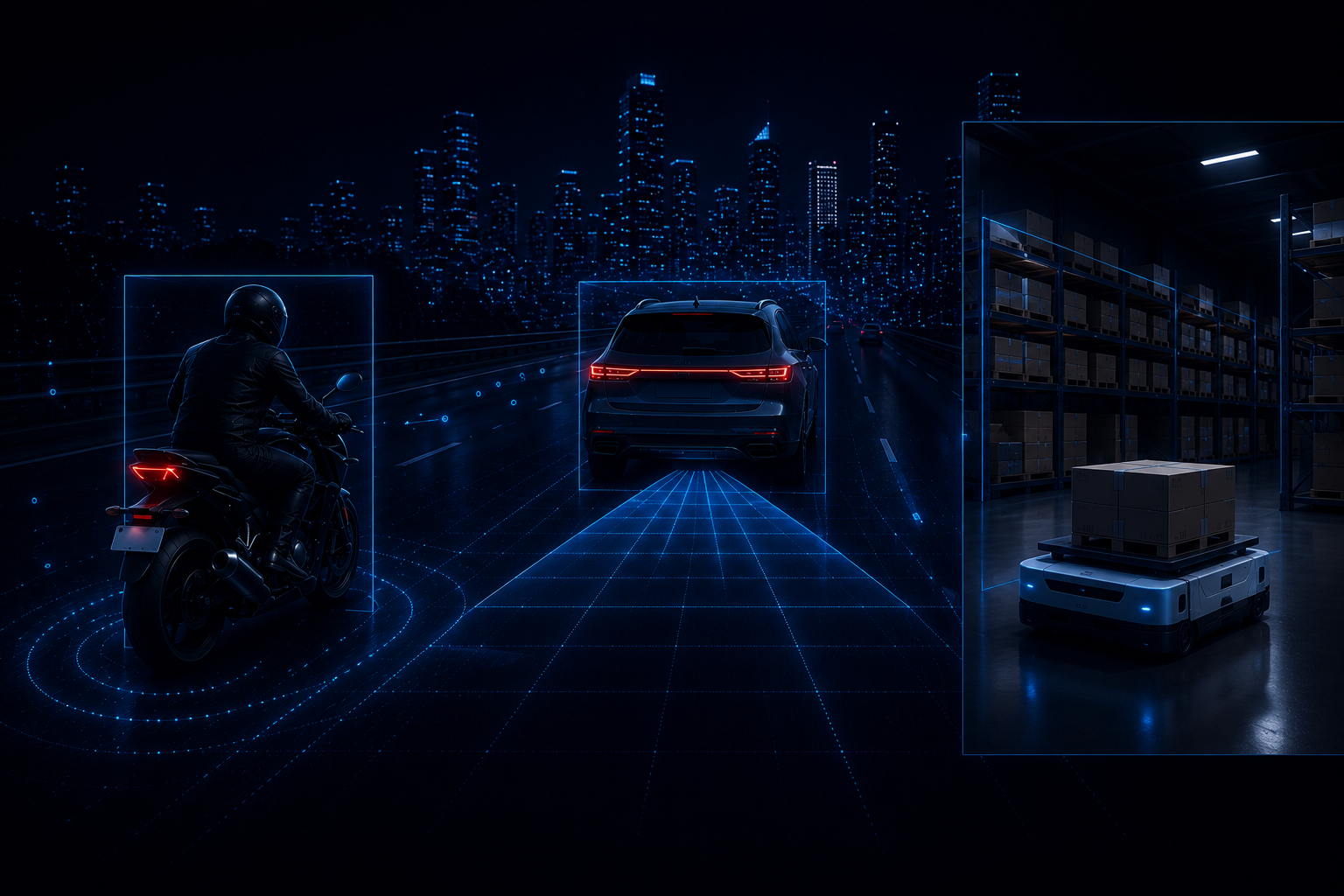
Beyond the bike, EdgeVerse has built Perceiva DMS, a camera-based Driver Monitoring System for commercial vehicles that watches for drowsiness and distraction, alongside a radar perception stack — and the same edge-AI perception is now being explored for industrial automation and defence. The backing has followed the engineering: the company previously received Rs 18.5 million in seed funding from ARTPARK and was selected as a winner of the NASSCOM Mobility Innovation Challenge 2025, and in August 2026 GVFL invested Rs 30 million to support India-specific road intelligence, camera and radar technology, and the commercialisation of its perception solutions. As co-founder and CEO Arindam Ghosh puts it, the vision is to make life-saving edge intelligence accessible — and to build technology in India that can compete globally.
With domestic two-wheeler sales reaching 21.7 million in FY2025-26, the highest the segment has ever recorded, the moment for this technology is now. If EdgeVerse succeeds, the next generation of Indian two-wheelers will not just be cheaper or faster than the world’s — they will be watchful, warning their riders a heartbeat before trouble arrives, and turning the most exposed seat on Indian roads into one of the safest.
More Read
Keep reading: The Car That Runs on Sunlight: Inside Vayve Mobility’s Eva, India’s First Solar Electric Car · The Car That Reverses Itself: Inside Swaayatt Robots, the Bhopal Startup Teaching Any Vehicle to Drive Itself · More Automotive & Mobility stories
Like stories like this? Add Exceptional Technology as a preferred source on Google to see more of our reporting in your search results and Discover feed.