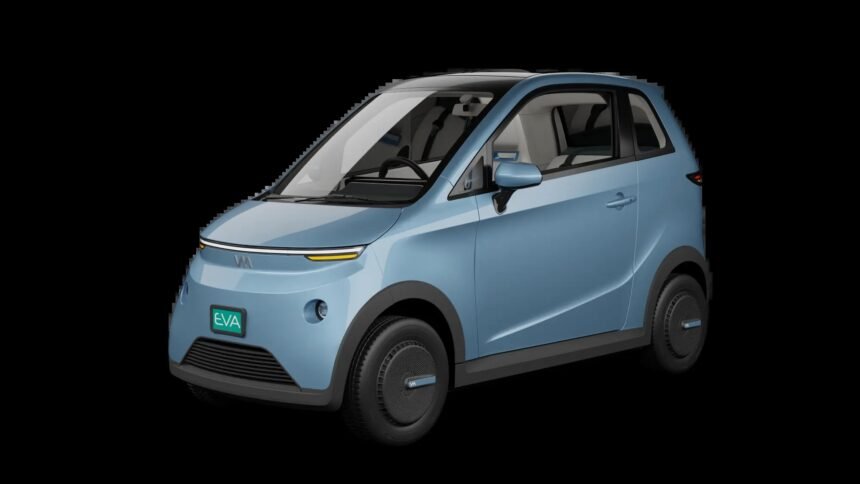
Every Indian city commuter knows the arithmetic of the daily drive: short trips, crawling traffic, a car built for the highway doing a job that rarely needs one. In Pune, Vayve Mobility looked at that arithmetic and asked a different question — what if the car itself were designed around the commute, and what if the sun paid for part of every trip? The company’s answer is Eva, which it calls India’s first solar electric car: a tiny, purpose-built city car with a solar panel on its roof, seats for two adults and a child, and a starting price the company puts at ₹3.25 lakh.
Vayve Mobility, incorporated in Pune in 2021, builds Eva around one idea — that most urban journeys are short, slow and lightly loaded, so the vehicle carrying them out should be light, narrow and ruthlessly efficient. The car is roughly three metres long and just over a metre wide, small enough to thread through congested streets and slip into parking spaces that bigger cars must pass by. Yet inside, the company says, it carries two adults and a child in comfort, with air conditioning, power windows and a cabin designed for daily use rather than weekend escapes.
A roof that earns its keep
The headline feature is the solar roof. A panel set into Eva’s roof harvests sunlight while the car drives and while it sits parked, and the company says it generates roughly a unit of electricity a day in typical Indian conditions — enough for 10 to 12 kilometres of driving, or up to 3,000 kilometres of free solar driving over a year. For a commuter whose daily run is short, the company says, that can cover a meaningful share of the year’s travel without ever touching a plug.
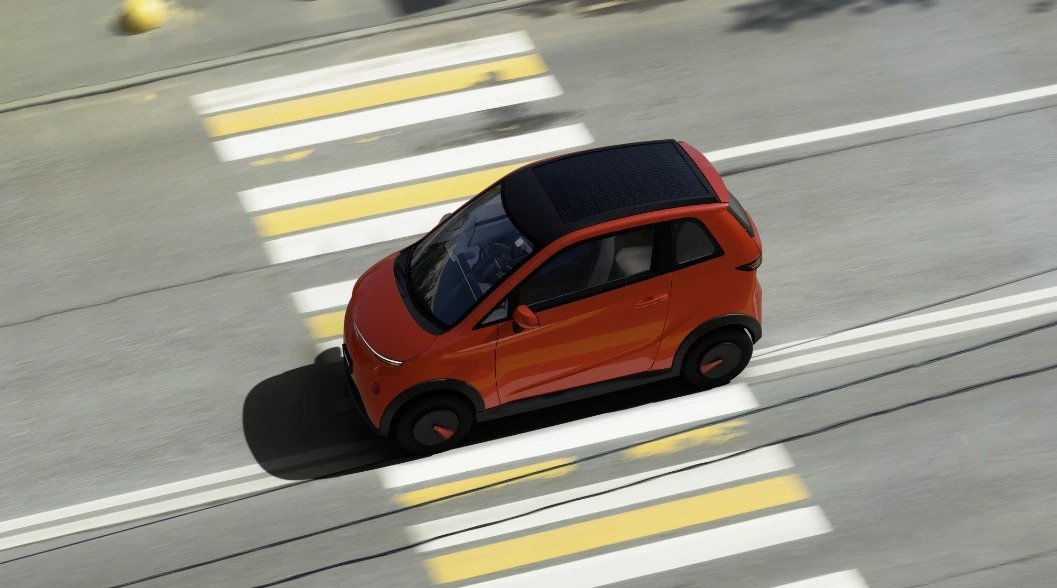
Underneath, Eva runs on a stable LFP battery chemistry the company chose to suit Indian heat, with a liquid-cooled pack on the top variant. The car sprints from 0 to 40 km/h in five seconds — the burst that matters most in city traffic — and tops out at 70 km/h, exactly the envelope a city car needs. Safety for urban driving comes from a monocoque chassis, a driver airbag and a front crumple zone, while smart connectivity — over-the-air updates, app integration and Android Auto and Apple CarPlay — keeps the car current without a service visit.
Three variants, and a battery you can rent
Eva comes in three variants. Nova, at ₹3.99 lakh, pairs a 9 kWh battery with 125 km of real-world range. Stella, at ₹4.99 lakh, steps up to a 12.6 kWh pack and 175 km. Vega, the flagship at ₹5.99 lakh, carries an 18 kWh battery for 250 km, adds CCS2 fast charging, a tyre-pressure monitoring system, a laptop charger and even a chill box. The company also offers a battery-subscription route that drops the upfront price further — Nova from ₹3.25 lakh, Stella from ₹3.99 lakh and Vega from ₹4.49 lakh — with battery use billed at ₹2 per kilometre.
The company says the maths of ownership is where Eva makes its strongest case: it puts the car’s running costs at a fraction of a petrol hatchback’s, with fuel-cost savings of around 90%. For a household running a second car for school runs, office commutes and market trips, that turns the cheapest car in the showroom into one of the cheapest cars to live with.
More Read

Built in Pune, designed for the world’s crowded cities
Eva was unveiled at the Bharat Mobility Global Expo 2025 in New Delhi, and the response since has been emphatic: pre-bookings on the company’s website have now closed, with Vayve thanking buyers for what it calls an overwhelming response. Early buyers were offered an 8-year battery warranty, unlimited over-the-air updates and three years of complimentary data connectivity.
The car was designed using Autodesk Fusion, and chief executive Nilesh Bajaj says Eva was designed not just for India but for the crowded cities of Southeast Asia, Africa and Europe too — places where, as in Pune, the streets are dense, the infrastructure is overloaded and the daily commute is short. The leadership team behind it — Bajaj as CEO, Saurabh Mehta as CTO and Vilas Deshpande as COO — has spent years refining the car on feedback from Indian drivers, including revisions after its Auto Expo 2023 showing.
What Vayve Mobility is building, at its core, is a new kind of Indian car — one that treats sunlight as fuel, the city street as its natural habitat, and affordability as a design feature rather than a compromise. In a country where millions of short trips are made every day in cars built for another kind of journey, Eva makes the case that the right car for the commute was never a smaller version of a big car. It was a different car altogether.
Keep reading: The Car That Reverses Itself: Inside Swaayatt Robots, the Bhopal Startup Teaching Any Vehicle to Drive Itself · Forged Carbon, Wireless Charging and 170 km/h: Inside Magron Novus, the Bengaluru Startup Building India’s Smartest Electric Motorcycles · More Automotive & Mobility stories
Like stories like this? Add Exceptional Technology as a preferred source on Google to see more of our reporting in your search results and Discover feed.