


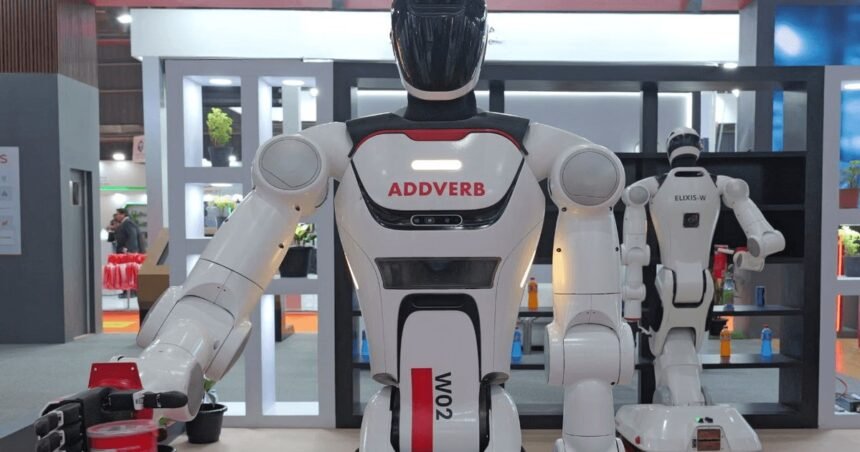
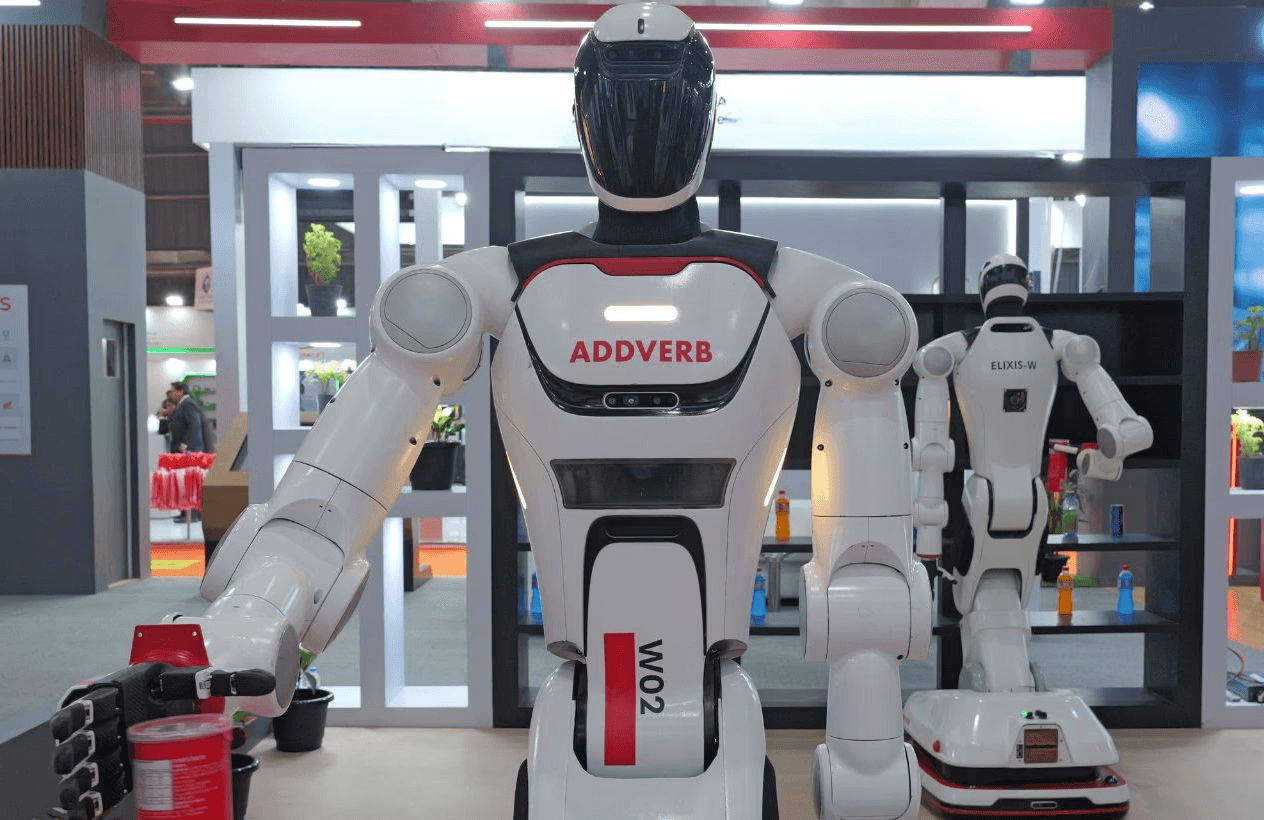
Every warehouse and factory floor in India was designed for people: aisles sized for footsteps, shelves set at arm’s height, workstations built around hands. For years, robots worked around those spaces rather than in them — bolted to the floor, fenced off, or rolling along fixed routes. In Noida, Addverb Technologies looked at that gap and built a machine shaped for the world as it already exists. Its answer is Elixis-W, which the company calls India’s first Made-in-India wheeled humanoid robot for industrial use: a machine with arms, hands and a wheeled base, unveiled on 5 February 2026 at LogiMAT India 2026 in Mumbai.
Addverb is no newcomer to industrial floors. Founded in 2016, the company has grown into one of India’s largest robotics firms, with the company saying its systems run in more than 500 warehouses for over 350 customers, from Reliance and Flipkart to HUL, PepsiCo, Maersk and DHL, and that it has deployed more than 2,000 robots. Elixis-W is the company’s step from machines that move goods to machines that can work the way people do.
Why wheels, not legs
The most deliberate choice in Elixis-W is the one in its name. Addverb chose wheels over legs, and the company says the reasoning is practical: most warehouses and factories have flat, structured floors, where wheels offer efficiency, stability and faster integration with existing infrastructure. A wheeled humanoid can start work in today’s facilities without the building changing around it, and the company says its teams can focus on task execution, safety and workflow integration instead of adapting floors to a new form of locomotion. A legged version of Elixis is also ready, the company says, but the wheeled version goes to the first customers.
Standing around six feet tall, Elixis-W pairs that mobile base with a genuinely human-shaped upper body: two arms, each fitted with a five-fingered dexterous hand, built for the picking, sorting, assembly and material-transport jobs that still need a human touch. The company says the two hands together lift 10 kg, and that the machine offers 43 degrees of freedom, plus 12 more in each hand — the flexibility that lets it handle objects with precision rather than just pushing them around.
A brain built for the shopfloor
What makes Elixis-W more than a mobile pair of arms is the intelligence on board. The company describes a Physical AI-ready architecture: the robot perceives its surroundings through stereo cameras and 3D LiDAR, navigates with visual SLAM, and runs a vision-language-action model directly on the machine, so it can perceive, plan and adapt to changing environments rather than simply following pre-programmed routines. Two NVIDIA Jetson units — Orin and Thor — supply the computing for perception, planning and control, and the company says the machine moves at up to 1.5 metres per second with around two hours of battery per charge.
The work it is built for is the work that wears people down: tasks that are repetitive, physically demanding or higher-risk, from moving materials across long warehouse aisles to handling goods in places where human presence is limited or hazardous. Addverb’s position, stated by co-founder and CEO Sangeet Kumar at the launch, is that humanoids are designed to work alongside people, not replace them — taking on the punishing jobs so human talent can focus on supervision, decision-making and higher-value work.
More Read

A careful, deliberate rollout
Addverb is rolling Elixis-W out slowly, and deliberately. The company says the first year will see a manufacturing batch of around 100 humanoids, deployed to no more than four or five customers through limited, closely supervised proof-of-concept deployments in controlled industrial environments, where safety, reliability and consistency are validated before any wider adoption. The company will test the robot in Reliance factories first, drawing on its long partnership with Reliance, before a larger rollout. Pricing, the company told Business Standard, will initially sit in the $80,000 to $100,000 range — between Chinese and Western humanoids.
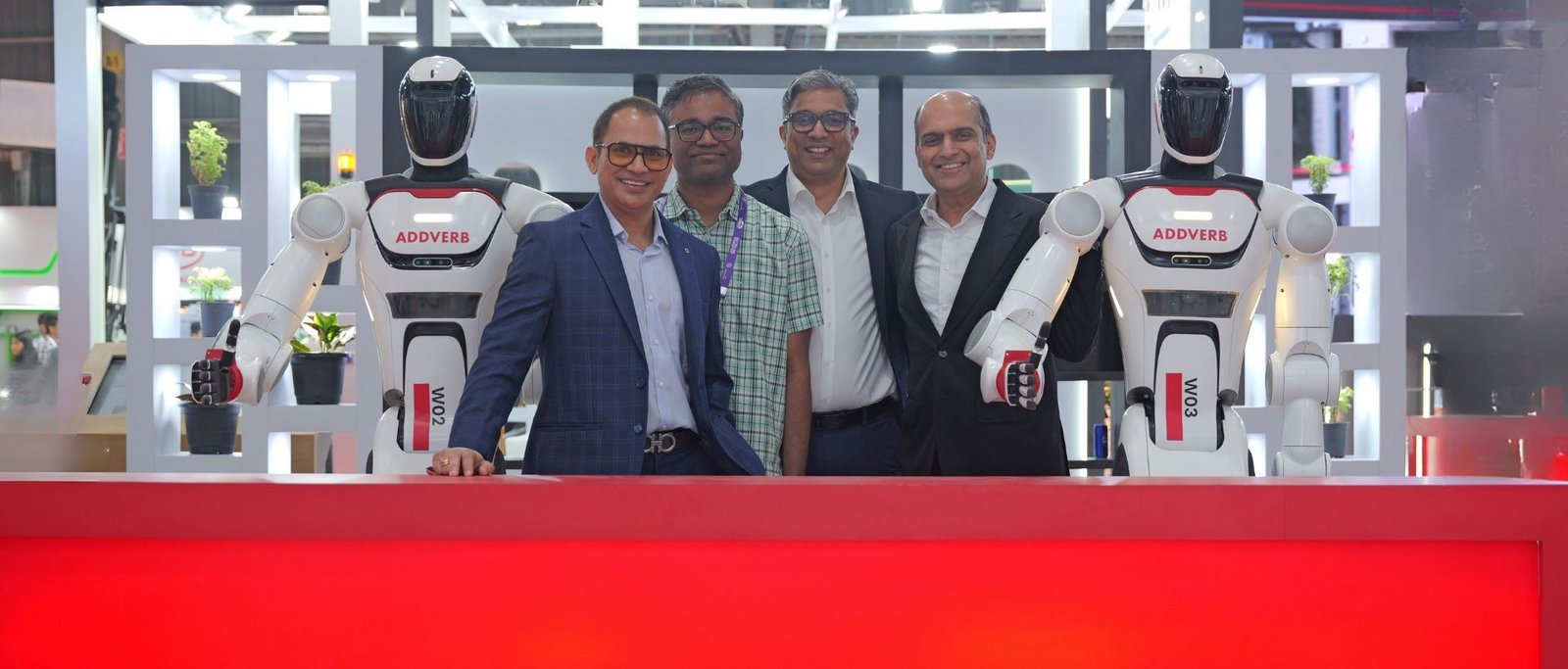
The launch at LogiMAT India also brought two more machines: the Cruiser 360, a four-way pallet shuttle for high-density storage, and FlowT, an autonomous forklift for busy warehouse floors, while the company’s Trakr quadruped robot walked the exhibition floor. Since the launch, Elixis-W has been showcased at the India AI Impact Summit in New Delhi and at SEMICON India, and the launch coincided with Addverb.ai, the company’s platform for general-purpose robotics. The company says it closed FY 2024–25 with ₹800 crore in revenue and is targeting more than ₹1,400 crore by FY27 — a decade after its founding, now building the machines that will share India’s factory floors.
Elixis-W is not a robot built for a stage. It is a robot built for aisles, shelves and shifts — a wheeled, watchful pair of hands that brings humanoid robotics out of the demo hall and onto the Indian shopfloor, where the real work happens.
Keep reading: Going Vertical: Inside Tech Mark, the Pune Company Automating India’s Warehouses · The Arms That Build India: Inside Kikobot Robotics, the Pune Startup Making Robot Arms Affordable · More Industrial Automation & Technology stories
Like stories like this? Add Exceptional Technology as a preferred source on Google to see more of our reporting in your search results and Discover feed.







