


Some aircraft need a runway. A loitering munition heading for a battlefield does not have that luxury — it has to leave its launcher fast, from wherever it happens to be, and be flying its mission seconds later. For months, the Lucknow defence startup HoverIt searched for a rocket-assisted take-off system that could do that job for its Divyastra loitering munition. Every option it found came from overseas, with prohibitive costs and lead times stretching into months. So the company made a decision: build it in India, in-house, from a blank sheet. Sixty days later, its home-grown RATO system launched the Divyastra in a live trial.

Sixty days, blank sheet to flight
RATO — rocket-assisted take-off — is a booster that gives an aircraft the kick it needs to get airborne from a short launcher, without a runway. HoverIt says its engineering team completed the entire development cycle in about sixty days: the design, the propellant integration, the manufacturing, the integration with the airframe and the live flight testing, all done in-house. No licensed design, no imported subsystem, no dependency on foreign lead times — the company describes it as indigenously designed, developed and manufactured, owning the full engineering chain from concept to flight. The programme ended in a live trial in which the indigenous RATO system successfully launched the Divyastra Mk1. The RATO system now joins HoverIt’s product portfolio as a proven launch solution, ready for integration with its own platforms and for domestic and international partners looking for a rapidly deliverable launch system.
The aircraft it launches: Divyastra Mk1
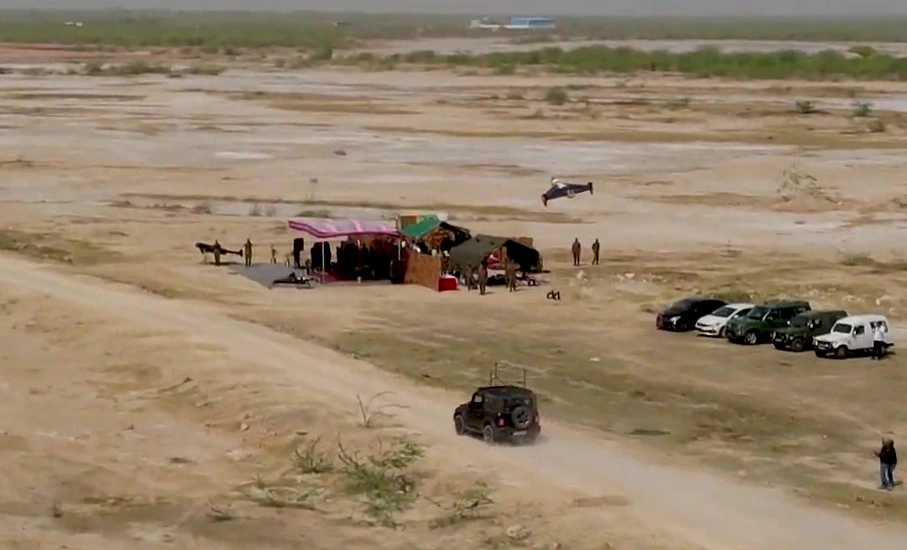
The Divyastra Mk1 is a tactical loitering munition — an unmanned aircraft designed to search an area, find its target and strike it, all on its own. The company says it can fly for up to five hours, cover an operational range of up to 500 kilometres, reach attack speeds of 300 to 400 kilometres per hour and carry a payload of 15 kilograms. It is built for fully autonomous flight, with AI-enabled target engagement and swarm capability, and it can be configured with electro-optical and infrared sensors, communication relay systems and different warhead configurations for different missions. The platform proved itself in front of its toughest audience on 1 June 2026, when HoverIt demonstrated the Divyastra Mk1 in the Jodhpur desert before senior Indian Army officers, launching it multiple times from a vehicle-mounted mobile launcher and showing off its rapid deployment, battlefield mobility and surveillance capabilities in the field. The company says around 95% of the aircraft’s components are locally sourced, and that it costs about a third of comparable foreign systems.

A family, not a single aircraft
More Read
Divyastra is a family, and the Mk1 is its first member. The Divyastra Mk2, now in development, is the long-range sibling: the company says it will fly 1,500 to 2,000 kilometres, stay airborne for eight to twelve hours and carry 50 to 100 kilograms. The Divyastra Mk3 is the jet-powered one — on 11 August 2026 it completed its maiden flight on an indigenous turbojet built by Delhi’s DG Propulsion, the first time an Indian jet-powered loitering munition had flown on an Indian engine. Around the Divyastra line, HoverIt builds a wider range of unmanned systems: Aankh, a compact surveillance drone with thermal imaging; Baaz, a payload-carrying platform for precision delivery and high-altitude work; and Raftaar, a fixed-wing aircraft with vertical take-off for long-range surveillance. Each one is designed and manufactured by the same team in Lucknow.
What comes next
HoverIt — which trades as Kawa UAV Private Limited — was founded in August 2022 by Saurav Singh Bhadauria, Ravinder Singh and Pawan Pandey, and works from the Lucknow node of the Uttar Pradesh Defence Industrial Corridor, next door to the BrahMos manufacturing complex. The company announced seed funding of $500,000 in January 2026, and it is now building a 55,000-square-foot manufacturing and research facility in Lucknow to scale production of the Divyastra family, with manufacturing operations set to begin by the end of 2026. From a startup that began by building surveillance drones, HoverIt has grown into a company that builds the aircraft, the launcher and the rocket that gets it into the air — and every part of that chain, the company says, is Indian. For a country building its own defence future, that is exactly the point: the launch, the aircraft and the engineering behind both now come from Lucknow.
Keep reading: The Shield for the Mach 5 Sky: Inside Kristellar Aerospace’s Hypersonic Countermeasure · The Drone That Keeps Flying When GPS Goes Dark: Inside Gamma Rotors’ NightHawk · More Aerospace & Defense stories
Like stories like this? Add Exceptional Technology as a preferred source on Google to see more of our reporting in your search results and Discover feed.









