


Every satellite overhead, every navigation fix on a phone, every power grid holding its rhythm — all of it runs on time. And the timekeepers that make it possible, atomic clocks, are among the most tightly controlled technologies on Earth. India has long had to import them. Now, a young Pune startup has built one at home — in seven months.
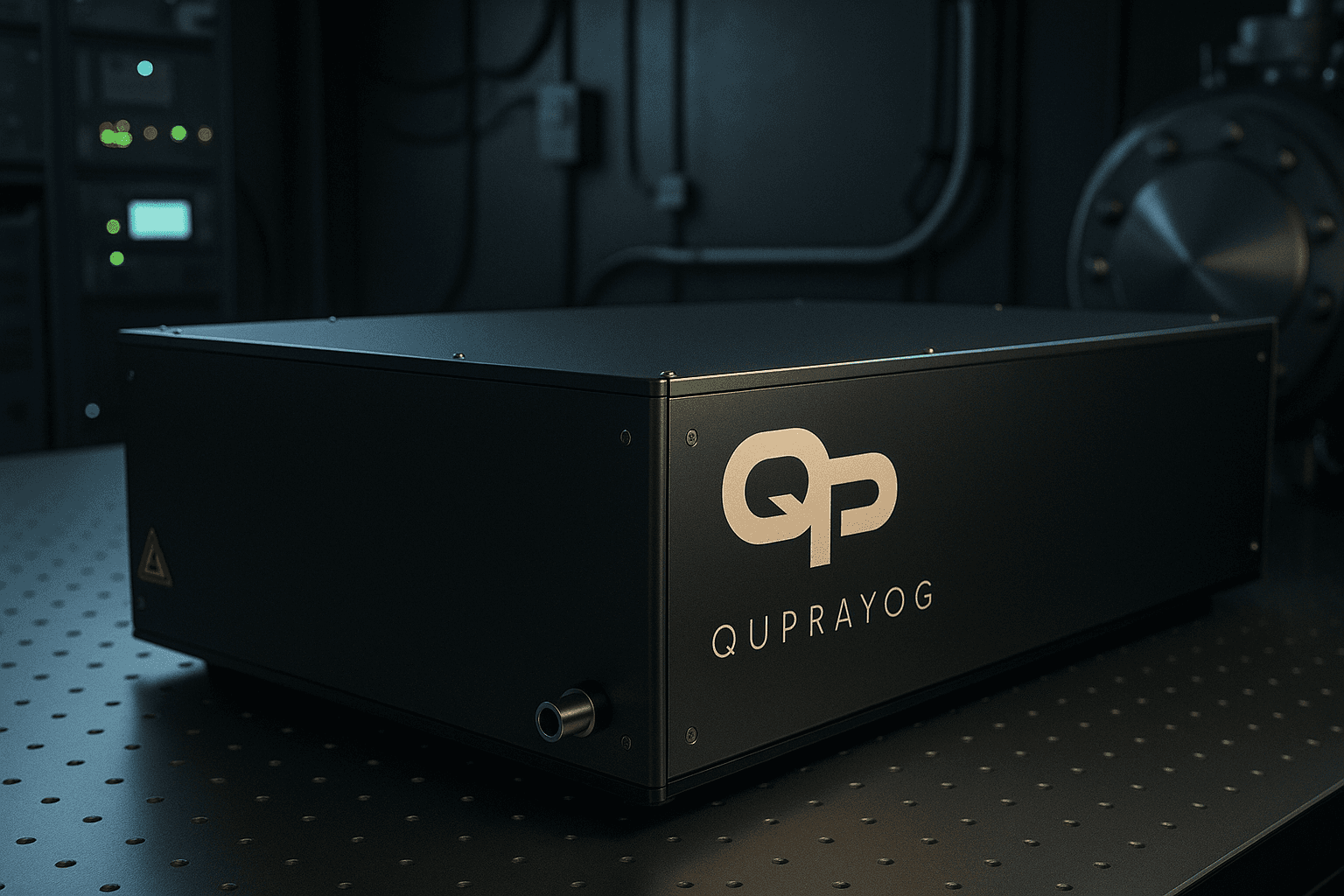
QuPrayog, a deep-tech startup spun out of the Indian Institute of Science Education and Research (IISER) Pune, has developed a laboratory-scale atomic clock prototype using rubidium-87 atoms. The company says the prototype has reached Technology Readiness Level 4, and laboratory tests show a frequency stability of about 3 × 10⁻¹⁰ over one second, improving to around 2 × 10⁻¹¹ over 100 to 1,000 seconds — roughly 50 times steadier than a conventional free-running crystal oscillator.
Why a clock this precise matters
Atomic clocks are the hidden heartbeat of modern infrastructure. Satellites in low Earth orbit need timing that is accurate, compact, lightweight and energy-efficient; navigation services must keep working even where GPS signals are disrupted or unavailable; and telecom networks, power grids and financial systems all lean on the same precise time. As India expands its satellite constellations, the demand for that timing is only growing — and, as The Hindu reports, international export controls on dual-use technologies have made access to advanced atomic clocks harder, making a domestic supply chain a strategic priority.
That is exactly the gap QuPrayog is building for. “Position, navigation and timing has always been central to India’s strategic independence,” says Dr Jay Mangaonkar, the company’s CEO and co-founder. “Our objective is to reduce India’s dependence on imported atomic clocks and establish a reliable domestic supply chain for high-performance timing systems developed and manufactured in India.”
Light, atoms and a steadier second
More Read
The prototype uses a technique called Coherent Population Trapping (CPT), in which carefully controlled laser light interacts with rubidium atoms to produce a very specific frequency. The optical approach drops the complex microwave cavity that conventional atomic clocks need, which the company says makes smaller, more power-efficient units possible.
On the company’s own specifications, the CPT rubidium clock delivers atomic-grade stability of 2 × 10⁻¹¹ at 100 to 1,000 seconds, drifts by no more than 5 × 10⁻¹¹ a month, and holds time to under one microsecond a day when GNSS is lost — putting out standard 10 MHz and 1 PPS signals from a rack-scale, drop-in-ready unit built for onboard positioning, navigation and timing references, synthetic-aperture-radar time-tagging and ground-station time transfer.
From lasers to a clock company
QuPrayog was founded in 2024 by Dr Jay Mangaonkar and Dr Rahul Sawant, and is incubated at the I-HUB Quantum Technology Foundation at IISER Pune, with support from the IIT Madras Incubation Cell. The startup is one of eight selected for support under the Department of Science and Technology’s National Quantum Mission, the eight-year, Rs 6,003.65 crore programme launched in 2023 to build India’s quantum capabilities.
The clock is the flagship, but not the whole story. QuPrayog also builds the precision photonics underneath it — titanium-sapphire laser systems and optical frequency combs, the tools that make ultra-stable clocks possible in the first place. Its next product is already on the drawing board: a miniature atomic clock that packs CPT precision into just 50 cubic centimetres, so even the tightest satellite payload can carry a reference that holds time when GNSS cannot. Beyond that, the company is working towards optical atomic clocks, the next generation of timekeeping.
What comes next
The team is now refining the prototype’s reliability and packaging, with a miniature, integrated version planned by August 2027. From a seven-month sprint in a Pune lab to a product that could fly on Indian satellites, QuPrayog is building the timing layer India’s space and navigation ambitions will stand on — one extraordinarily steady second at a time.
Keep reading: No Remote, No Manual: Inside Fly Camp, the Bengaluru Startup Teaching India to Fly a Drone in Five Seconds · No Towers, No Satellites, No Problem: Inside Krathveil’s Pocket Radio for India’s Soldiers · More Aerospace & Defense stories
Like stories like this? Add Exceptional Technology as a preferred source on Google to see more of our reporting in your search results and Discover feed.









